I built a multi-tenant voice-AI SaaS on an $80 Raspberry Pi
I gave myself a rule this year: twelve startups in twelve months. Build, ship, learn, repeat. Project #1 is Stelt — a voice-first AI assistant that any business can add to its website with one line of code. It learns the business, talks to visitors out loud, and can pop a real lead form or play a video right on the page.
Here’s the part people don’t expect: the whole thing runs on a Raspberry Pi 4 sitting behind my desk. Not a Kubernetes cluster. Not a fleet of cloud instances. An $80 single-board computer.
This isn’t a stunt. It’s a deliberate strategy, and I want to walk through why.
The build-cheap, scale-later playbook
The expensive part of a startup isn’t the server. It’s the months you spend building something nobody wants. So the goal for every project this year is the same: get to “is this real?” as fast and as cheaply as possible.
A Raspberry Pi is perfect for that:
- It costs less than one month of a managed cloud database.
- It forces me to keep the architecture simple — no runaway bills hiding behind autoscaling.
- When a product proves itself, moving it to a “real” server is a deploy script, not a rewrite.
The Pi is the proving ground. The cloud is the reward for traction.
The rack behind my desk
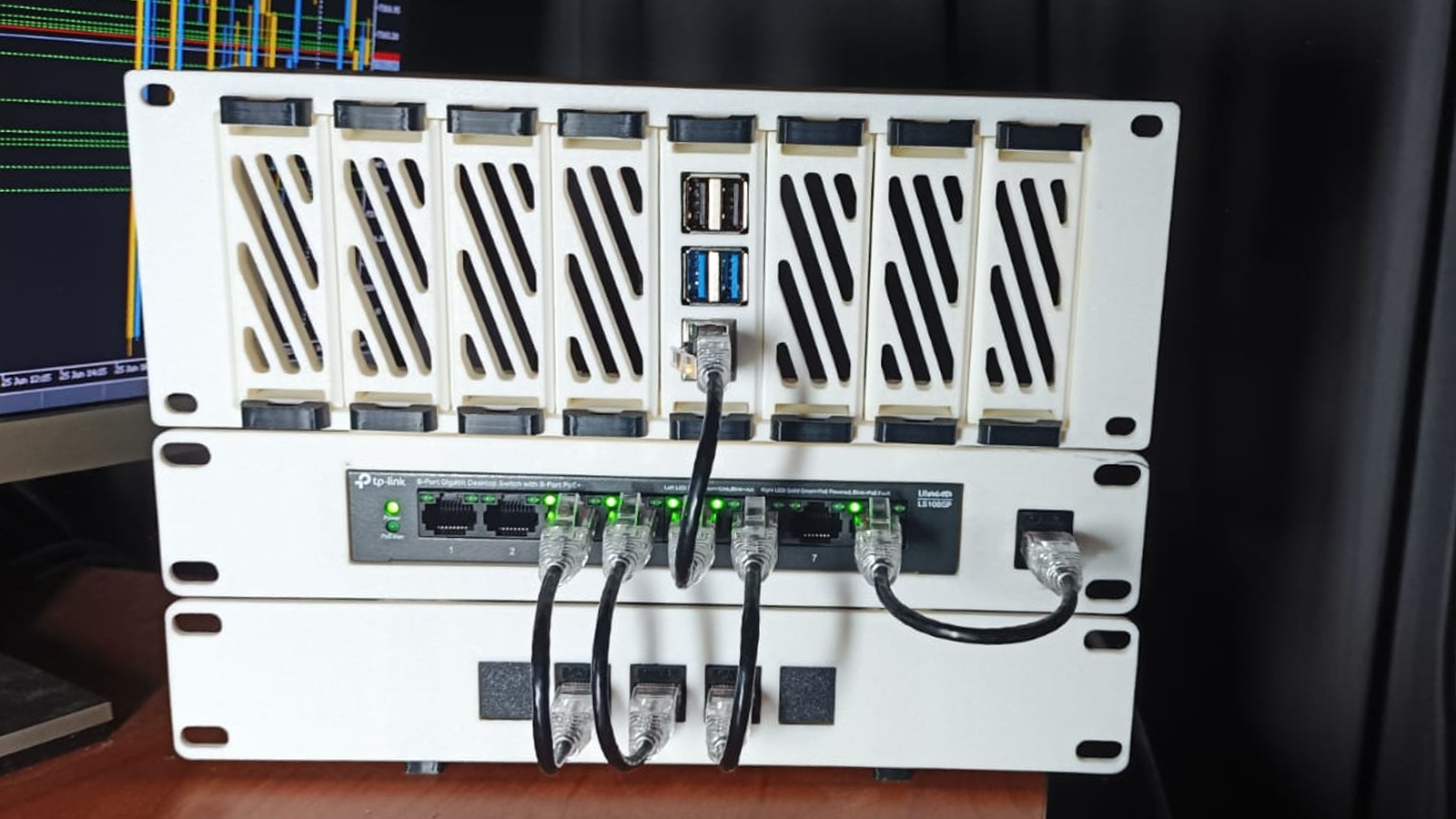
That photo at the top isn’t a stock image — it’s the actual machine. The Pi lives in a 3D-printed 10-inch rack I run on the desk: a 4U frame with eight bays, a TP-Link gigabit PoE switch, and a patch panel across the bottom that wires everything back to my dev box and my laptop over Ethernet.
Notice that only one bay is filled. That’s the whole idea. The plan is one project per Pi — every new build this year gets its own board, its own isolated little server, slotted in next to the last one. The empty bays are basically my roadmap, and I can see it from my chair.
The switch and patch panel keep the workflow honest, too. I write and test code on a separate machine, then deploy to the Pi over the local network — the same shape as shipping to a real cloud server later, just cheaper, quieter, and sitting two feet away.
The architecture
Stelt is multi-tenant from day one — many businesses, one codebase. The stack is intentionally boring:
- Node + Express serving a marketing site, a dashboard, and an embeddable widget.
- SQLite for storage. On a single box, SQLite is faster than people give it credit for, and there’s no second service to babysit.
- Cloudflare Tunnel so the Pi is reachable at a real domain over HTTPS without exposing a single port to the internet.
- Bring-your-own keys — each business plugs in its own AI and voice keys, so their traffic hits their bill, not mine. That single decision is what makes running on cheap hardware viable: I’m not paying for anyone’s usage.
The widget streams the assistant’s reply sentence by sentence and starts speaking the first sentence before the rest has even finished generating — so it feels like a conversation, not a loading spinner.
What cheap hardware teaches you
Constraints are clarifying. Because there’s no room to be wasteful, every choice gets sharper:
If it won’t run smoothly on a Raspberry Pi, it probably has a design problem I’d rather find now than after launch.
Rate limiting, careful token budgets, batching the text-to-speech calls instead of firing one per sentence — these are things you’d eventually want at scale anyway. The Pi just makes you do them on day one.
Where this goes next
When Stelt has paying customers, it moves to a dedicated cloud server and the Pi becomes the sandbox for the next feature. Then project #2 gets its own Pi, and the cycle repeats. Twelve times.
If you want a voice assistant that knows your business and talks to your visitors, that’s exactly what Stelt does — and you can be one of the first to use it.
I’ll keep writing these as I build. Follow along.
Give your own website a voice
Stelt is a voice-first AI assistant that learns your business and talks to your visitors — added with one line of code.